“Hana Nguni Hana Mangke, Tan Hana Nguni Tan Hana Mangke”
“What exists today exists because it existed before; without that which existed before, that which exists today could not exist.”
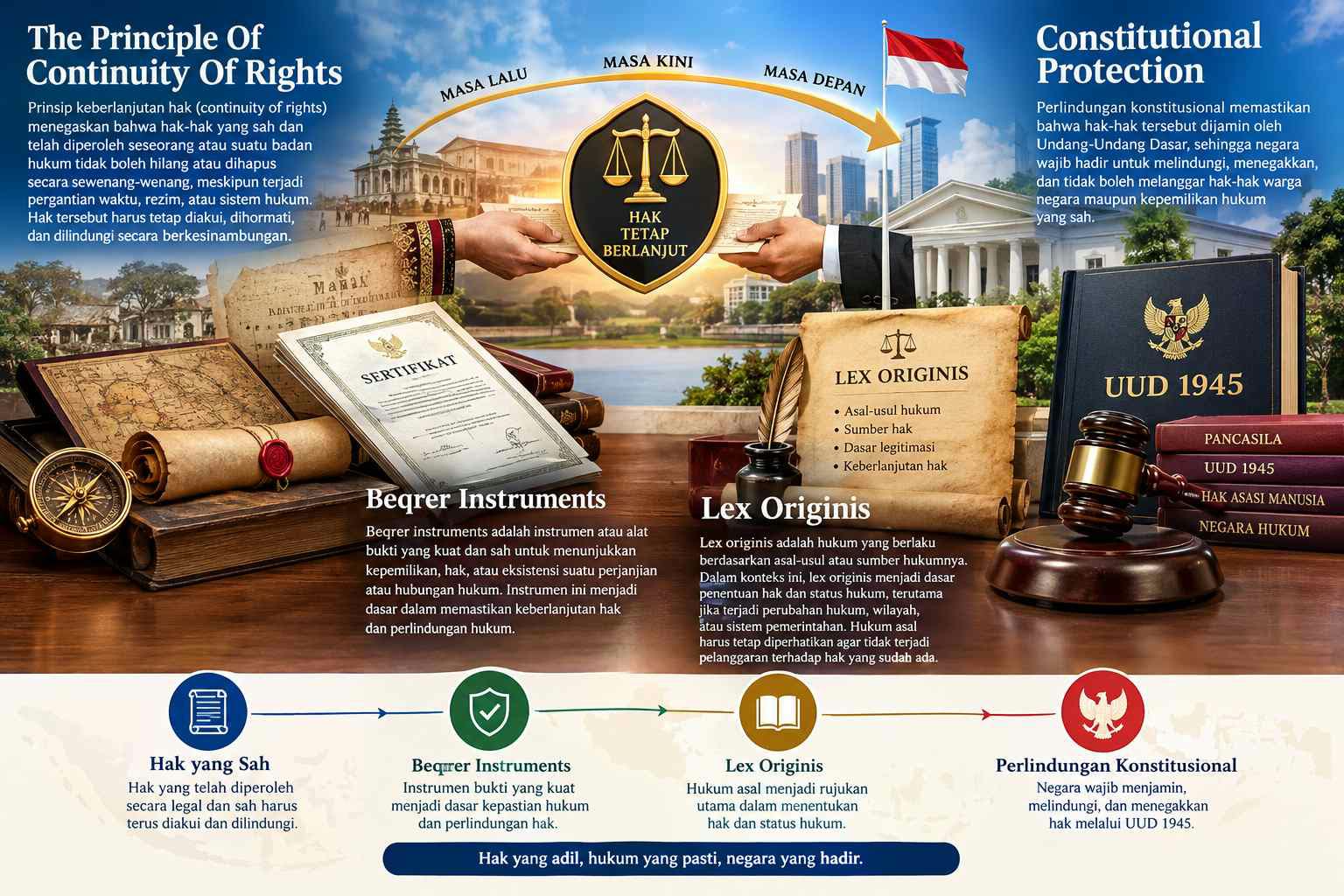
Porosmedia.com – This principle, derived from the Amanat Galunggung, establishes that every right, authority, legal standing, document, mandate, and proprietary interest existing in the present must be understood through its origin, historical continuity, and legal foundation.
Accordingly, the legal status of any document, proprietary right, bearer instrument, bond, share certificate, dividend entitlement, mandate, or administrative record cannot be evaluated solely by its current administrator, manager, institution, or governing structure. It must first be examined through its Lex Originis—the lawful origin from which the right was created and derived.
MORAL AND ETHICAL FOUNDATION
Amanat Galunggung
The Amanat Galunggung establishes continuity, origin, and mandate as the fundamental basis of legitimacy and authority.
Self-Reliance (Berdikari)
This principle aligns with the constitutional spirit of:
“Berdiri di Atas Kaki Sendiri” (Standing on One’s Own Feet)
which recognizes the dignity, historical inheritance, identity, lawful rights, and independence of a people founded upon their own legitimate origins.
The Bandung Principles of 1955
The Ten Principles of Bandung affirm:
- Respect for sovereignty.
- Equality among nations.
- Respect for legitimate rights.
- Non-interference in internal affairs.
- Justice-based settlement of disputes.
- Mutual respect and cooperation.
- Peaceful coexistence among peoples and nations.
CONSTITUTIONAL FOUNDATION OF THE REPUBLIC OF INDONESIA
Private rights, lawful ownership, mandates, and legitimate interests receive constitutional protection under the following provisions of the 1945 Constitution (UUD 1945):
- Article 18B: Recognition and respect for lawful traditional and historical rights.
- Article 27: Equality before the law and government.
- Article 28C: The right to self-development and the collective pursuit of legitimate interests.
- Article 28D: The right to legal recognition, protection, and certainty.
- Article 28E: Freedom of conviction and lawful expression.
- Article 28F: The right to obtain, possess, process, retain, and convey information.
- Article 28G: Protection of personal dignity, honor, security, and lawful interests.
- Article 28H Paragraph (4): Protection of private property rights against arbitrary deprivation.
- Article 29: Freedom of religion, conscience, and lawful mandates.
- Article 33 Paragraph (3): Management of natural resources for the prosperity of the people, while respecting lawful rights and public welfare.
LEGAL FOUNDATION
- Lex Originis: A right derives its legitimacy from its lawful origin and continuity, not merely from its subsequent administration.
- Lex Privata: Private rights lawfully acquired remain protected and recognized under the law.
- Lex Mercatoria: Commercial rights and instruments must be assessed within the framework of historical commercial law and established commercial practice.
- Burgerlijk Wetboek (BW) Staatsblad No. 23 of 1847: Including, but not limited to:
- Book II: Articles 499, 503–505, 569–571, 613–616;
- Book III: Articles 1792–1803;
- Book IV: Articles 1866, 1870–1875.
These provisions govern property, possession, ownership, mandates, obligations, securities, legal proof, and evidence.
LEGAL CHARACTERISTICS OF AAN TOONDER INSTRUMENTS
Definition
An Aan Toonder (Bearer Instrument) is a negotiable instrument whose rights are attached to the lawful possession of the original instrument as issued under the law applicable at the time of issuance.
Essential Characteristics
- Issued only once in authentic form.
- Possesses a unique issuance number.
- Features an identifiable issuer.
- Represents a stated value or entitlement.
- Frequently accompanied by dividend coupons (Dividendbewijzen).
- Contains rights intrinsically attached to the physical instrument itself.
- Recognized within historical commercial and civil law systems.
PRINCIPLE OF DOCUMENTARY CONTINUITY
The principle of continuity affirms that:
- Rights precede administration.
- Documents precede administrators.
- Mandates precede institutions.
- Ownership precedes management.
Administrators may change.
Governments may change.
Corporate structures may change.
Institutions may change.
However:
The historical and legal existence of a lawfully issued document does not cease to exist merely because administrative control subsequently changes.
CONTINUITY OF CIVILIZATION, TRADE, AND ADMINISTRATION
Within the framework of Lex Originis:
Amanat Galunggung
↓
Galunggung Heritage and Mandate
↓
Sunda Land
↓
Pajajaran Civilization
↓
Sunda Kalapa Port
↓
The Sunda Strait International Trade Route
↓
Trade in Camphor, Benzoin, Resin, Agarwood, and Other Nuswantara Commodities
↓
International Maritime Commerce
↓
Historical Archives and Publications
↓
Commercial Instruments and Financial Securities
↓
Bearer Shares (Aan Toonder)
↓
Bonds and Dividend Certificates
↓
N.V. Administrative Structures
↓
Authentic Notarial Documentation
↓
International Apostille Certification
PRINCIPLE GOVERNING DOCUMENTARY STATUS
The legal standing of any document shall be determined by:
- Its lawful origin.
- Its authenticity.
- Its physical existence.
- Its traceable chain of custody.
- Its administrative continuity.
- The legal framework in effect at the time of issuance.
- Its historical publication, registration, and documentary record.
CLOSING PRINCIPLE
Rights do not originate from administration; rights originate from the legal source that created them.
Documents do not derive legitimacy from subsequent administrators; administrators derive administrative authority because lawful documents and lawful rights existed beforehand.
“Hana Nguni Hana Mangke, Tan Hana Nguni Tan Hana Mangke.”
“What existed before gives rise to what exists today; without that which existed before, that which exists today could not exist.”
This principle forms the foundation for the continuity of rights, mandates, ownership, documentary evidence, and administrative legitimacy under Lex Originis, Lex Privata, Lex Mercatoria, BW Staatsblad No. 23 of 1847, the Constitutional Principles of the Republic of Indonesia, the Spirit of Berdikari, and the Moral Foundation of the Bandung Principles of 1955.
PRASASTY5A111G101/CHORD 800/X/2026